
 Medically Cited |
Author
Last updated: September 10, 2026
Quick Answer: The best nootropic supplements for brain fog in 2026 include citicoline, lion’s mane mushroom, L-theanine, Bacopa monnieri, rhodiola rosea, phosphatidylserine, and N-acetyl L-tyrosine. Each targets a distinct cognitive pathway, from acetylcholine production to cortisol regulation, making them effective individually or as a stack. Most people notice meaningful improvements within 2-8 weeks of consistent use.
Key Takeaways
- Brain fog is not a diagnosis but a symptom cluster involving poor focus, slow recall, and mental fatigue, nootropic supplements address its underlying neurochemical causes.
- Citicoline and phosphatidylserine have the strongest clinical evidence for memory and attention in adults [1][3].
- Lion’s mane mushroom has “moderate evidence” (tier 2) for cognition and neuroprotection, with several clinical trials completed in 2025-2026 [28].
- L-theanine combined with caffeine is one of the most studied focus combinations; it works well for people sensitive to stimulants.
- Rhodiola rosea is particularly effective when brain fog is stress-driven rather than sleep-deprivation-driven [4].
- Natural nootropics are generally safer for long-term use than synthetic racetams, though both categories carry risks at high doses.
- Most nootropic supplements cost $20,$80/month; multi-ingredient stacks tend to run $50,$100/month.
- People with thyroid disorders, pregnant women, and those on SSRIs or blood thinners should consult a physician before starting any nootropic regimen.
- Stacking more than 4-5 compounds simultaneously is a common beginner mistake, start with 1-2 and add gradually.
- The FDA issued a warning in February 2026 requiring certain novel “nootropic” ingredients to submit NDI notifications or be reformulated before sale as dietary supplements.
What Are Nootropics and How Do They Work?
Nootropics are compounds, natural or synthetic, that support cognitive function, including memory, attention, processing speed, and mental clarity. The term was coined in 1972 by Romanian chemist Corneliu Giurgea, who defined them as substances that enhance learning without significant side effects [10].
They work through several mechanisms:
- Cholinergic support: Increasing acetylcholine, the neurotransmitter most associated with memory and learning (citicoline, alpha-GPC).
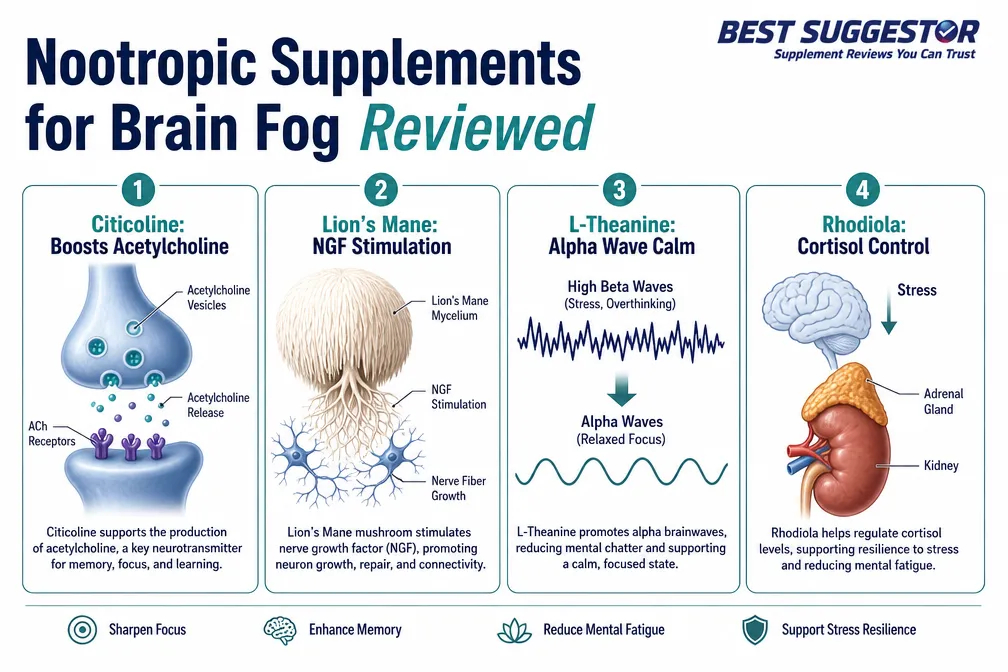
- Neuroplasticity: Stimulating nerve growth factor (NGF) to support new neural connections (lion’s mane mushroom).
- Stress adaptation: Reducing cortisol and oxidative stress that impair cognition (rhodiola, ashwagandha).
- Cerebral blood flow: Improving oxygen and glucose delivery to brain cells (ginkgo biloba, vinpocetine).
- Neurotransmitter balance: Modulating dopamine, serotonin, and GABA pathways (L-tyrosine, L-theanine) [5].
Brain fog specifically responds best to compounds that address its root cause. If your fog is stress-driven, adaptogens like rhodiola work better. If it’s attention-related, cholinergic compounds like citicoline are a stronger fit.
The 7 Best Nootropic Supplements for Brain Fog
Here are the seven compounds with the strongest evidence-to-safety ratio for clearing brain fog in 2026. I’ve ranked them by breadth of evidence, not by popularity.
1. Citicoline (CDP-Choline)
Citicoline is arguably the most evidence-backed nootropic supplement for cognitive function. It raises acetylcholine and phosphatidylcholine levels, both critical for memory encoding and mental clarity [1]. A systematic review of multi-ingredient nootropic supplements found citicoline consistently associated with improved attention and working memory in middle-aged and older adults [3].
Dosage: 250-500 mg/day. Best for: Memory lapses, slow mental processing, post-illness brain fog.
2. Lion’s Mane Mushroom (Hericium erinaceus)
Lion’s mane stimulates NGF synthesis, which supports the maintenance and growth of neurons. As of 2026, multiple clinical trials have completed enrollment, including one comparing two extract types on cognition and gut outcomes, and current reviews classify it as having moderate (tier 2) evidence for cognition and neuroprotection. It’s most promising for older adults with cognitive complaints, though results in otherwise healthy adults remain preliminary.
Dosage: 500-1,000 mg/day of a standardized extract. Best for: Long-term neuroprotection, age-related cognitive decline, foggy thinking in people over 45.
For a broader look at evidence-backed options, see our best nootropics for focus and brain health guide.
3. L-Theanine + Caffeine
L-theanine, an amino acid from green tea, promotes alpha-wave brain activity, the mental state associated with calm focus. Paired with caffeine, it blunts jitteriness while extending the focus window. This is one of the most replicated combinations in cognitive research [8].
Dosage: 100-200 mg L-theanine with 50-100 mg caffeine. Best for: Daily productivity, reducing stimulant side effects, mild attention issues.
4. Bacopa Monnieri
Bacopa is an Ayurvedic herb with well-documented effects on memory consolidation. It works slowly, most studies show significant effects after 8-12 weeks, but the improvements in recall speed and verbal learning are consistent across multiple trials [2][5].
Dosage: 300-450 mg/day of a 55% bacosides extract. Best for: Students, professionals needing sustained memory improvement, chronic brain fog.
5. Rhodiola Rosea
Rhodiola is an adaptogen that reduces the cognitive impact of stress by modulating cortisol and supporting dopamine/serotonin balance. A 2021 review confirmed its effects on fatigue-induced cognitive decline [4]. If your brain fog worsens during high-stress periods, rhodiola is worth prioritizing.
Dosage: 200-400 mg/day of a 3% rosavins extract. Best for: Stress-related brain fog, burnout, mental fatigue.
6. Phosphatidylserine (PS)
Phosphatidylserine is a phospholipid that makes up a significant portion of neuronal cell membranes. It supports cell signaling, glucose metabolism in the brain, and cortisol regulation. The FDA has acknowledged a qualified health claim for PS and cognitive dysfunction risk reduction [1][3].
Dosage: 100-300 mg/day. Best for: Age-related memory decline, cortisol-driven fog, ADHD-adjacent attention issues.
7. N-Acetyl L-Tyrosine (NALT)
NALT is a bioavailable form of the amino acid tyrosine, a precursor to dopamine and norepinephrine. It’s particularly effective at restoring cognitive performance under sleep deprivation or high cognitive load, two of the most common triggers for brain fog [6].
Dosage: 300-600 mg/day. Best for: Sleep-deprived brain fog, high-demand work periods, dopamine-related motivation dips.
For detailed individual product breakdowns, our best brain supplements guide covers top-rated formulas containing these ingredients.
Do Nootropics Actually Work? Scientific Evidence
Yes, but with important nuance. The evidence quality varies significantly by compound and population. Citicoline, phosphatidylserine, and L-theanine have the most consistent human trial data. Bacopa and rhodiola have strong evidence in stressed or older populations but weaker data in healthy young adults [3][5].
A 2022 systematic review found that multi-ingredient nootropic supplements produced measurable improvements in processing speed and episodic memory in middle-aged and older adults, though effect sizes were moderate rather than dramatic [3]. A separate review of plant-derived nootropics confirmed cognitive benefits for Bacopa, ginkgo, and rhodiola across multiple randomized controlled trials [5].
Key caveat: Most studies run 4-12 weeks. Long-term data (1+ year) is sparse for nearly all nootropic compounds. This doesn’t mean they’re unsafe, it means the evidence base is still maturing.
The FDA’s February 2026 warning about novel nootropic ingredients underscores the importance of sticking with well-studied compounds rather than chasing the newest branded ingredient.
Nootropics vs Prescription ADHD Medication
Nootropic supplements are not substitutes for prescription medications like Adderall or Ritalin in diagnosed ADHD. Prescription stimulants act on dopamine and norepinephrine transporters with strong, fast-acting effects. Nootropics work more gently, often over weeks, and without the same regulatory oversight [10].
Choose nootropics if:
- You have mild, situational brain fog (stress, poor sleep, diet-related).
- You want a stimulant-free daily cognitive support routine.
- You’re looking to complement (not replace) a medical treatment plan.
Stick with prescription medication if:
- You have a formal ADHD diagnosis with significant functional impairment.
- You’ve tried nootropics for 8+ weeks without meaningful improvement.
- Your physician has assessed and recommended pharmacological treatment.
The sublingual nootropic format gaining traction in mid-2026, using ingredients like Cognatiq (formerly NeuroFactor), citicoline, L-theanine, and rhodiola, positions itself explicitly as a non-stimulant, everyday focus option. It’s a reasonable middle-ground for people who find coffee too harsh and don’t want a prescription.
How Long Does It Take for Nootropics to Work?
Onset time depends heavily on the compound and the mechanism involved.
| Compound | Expected Onset | Peak Effects |
|---|---|---|
| L-Theanine + Caffeine | 30-60 minutes | Same day |
| Rhodiola Rosea | 1-2 weeks | 4-6 weeks |
| Citicoline | 1-2 weeks | 4-8 weeks |
| Lion’s Mane | 4-6 weeks | 8-12 weeks |
| Bacopa Monnieri | 4-6 weeks | 8-12 weeks |
| Phosphatidylserine | 2-4 weeks | 6-8 weeks |
| NALT | 1-2 hours (acute) | Ongoing with daily use |
Common mistake: Stopping a nootropic after two weeks because “nothing happened.” Bacopa and lion’s mane require consistent use for 2-3 months before full effects are measurable. Set a 90-day evaluation window before making a judgment call.
Are Nootropics Safe Long Term?
Most well-studied natural nootropics are considered safe for long-term use at recommended doses, but “natural” does not automatically mean risk-free [9]. Here’s what the evidence actually says:
- Citicoline: Well-tolerated in studies up to 90 days; no serious adverse events reported at standard doses [1].
- Bacopa: Can cause GI discomfort (nausea, cramping) in some users; take with food.
- Rhodiola: Generally safe; rare reports of irritability or insomnia at high doses.
- Lion’s Mane: No significant safety signals in human trials to date, though long-term data is limited.
- Phosphatidylserine: FDA-recognized as generally safe; sourced from soy or sunflower (not bovine cortex) in modern supplements.
Long-term synthetic nootropic use (e.g., racetams) carries less studied risk profiles and is not recommended without medical supervision [10].
Which Nootropics Are Best for Focus vs Memory?
For focus: L-theanine + caffeine, citicoline, NALT, and rhodiola are the strongest options. They work on attention networks and dopaminergic pathways that govern task engagement.
For memory: Bacopa monnieri, phosphatidylserine, and lion’s mane target memory consolidation, synaptic density, and long-term potentiation.
For both: Citicoline and phosphatidylserine overlap both categories and are excellent anchors for any nootropic stack.
If you want a deeper breakdown of focus-specific formulas, our best nootropics for focus and brain health page covers top-rated products by use case.
Nootropics for Anxiety and Brain Fog
Brain fog and anxiety frequently co-occur, chronic anxiety elevates cortisol, which impairs hippocampal function and working memory. Nootropics that address both simultaneously include:
- L-Theanine: Reduces anxiety markers without sedation; promotes calm alertness [8].
- Rhodiola Rosea: Lowers cortisol and improves stress resilience [4].
- Ashwagandha (KSM-66): Strong evidence for cortisol reduction and anxiety; indirect cognitive benefits via stress reduction [2].
- Phosphatidylserine: Blunts the cortisol stress response; supports mood stability [3].
Avoid high-dose stimulant-based nootropics (strong racetams, high-caffeine stacks) if anxiety is a primary concern, they can worsen symptoms.
For lifestyle strategies that complement supplementation, our self-care tips for better brain health guide is a practical companion read.
Natural Nootropics vs Synthetic: Which Is Better?
Neither category is universally superior, the right choice depends on your goals, risk tolerance, and health status [10].
Natural nootropics (herbs, mushrooms, amino acids):
- Broader safety data in general populations
- Slower, more gradual effects
- Better suited for daily, long-term use
- Regulated as dietary supplements (with limitations)
Synthetic nootropics (racetams, modafinil analogs):
- Faster, more pronounced effects
- Narrower safety data; less studied in healthy adults
- Some require prescriptions; others exist in regulatory grey zones
- Higher risk of tolerance and dependency with some compounds
For most people researching bestsuggestor for everyday brain fog relief, natural nootropics offer the better risk-to-reward ratio. Synthetics may be worth exploring under physician guidance for specific clinical needs.
Our 5 top supplements for improving your brain article focuses specifically on natural options with strong safety profiles.
Can You Take Nootropics with Coffee?
Yes, and in many cases the combination is beneficial. L-theanine specifically pairs with caffeine to smooth out the stimulant’s side effects while extending focus duration [8]. However, a few caveats apply:
- Avoid stacking multiple stimulants: If your nootropic stack already contains caffeine (e.g., in a pre-formulated product), adding coffee on top can cause overstimulation, anxiety, or disrupted sleep.
- Timing matters: Take adaptogenic nootropics (rhodiola, ashwagandha) in the morning; avoid them in the evening as they can interfere with sleep onset.
- Citicoline + coffee: Fine for most people; some report enhanced focus without jitteriness.
- NALT + coffee: Generally compatible, but monitor for elevated heart rate.
The new sublingual nootropic formats emerging in 2026 are specifically designed as stimulant-free alternatives, a good option if you’re sensitive to caffeine but still want clean, sustained focus.
Nootropic Supplements Cost Comparison
Pricing varies widely based on ingredient quality, dosage, and whether you’re buying single compounds or pre-formulated stacks.
| Format | Typical Monthly Cost | Best For |
|---|---|---|
| Single compound (e.g., citicoline) | $15,$30 | Budget-conscious, targeted use |
| Dual stack (e.g., L-theanine + caffeine) | $20,$40 | Beginners, daily focus |
| Multi-ingredient stack | $50,$100 | Comprehensive brain fog support |
| Premium branded nootropic | $70,$120 | Convenience, quality-assured formulas |
Cost-saving tip: Buy single ingredients separately and build your own stack. You’ll pay less and have more control over dosages. For reviewed multi-ingredient products, our Mind Vitality review and Adderin brain booster review offer detailed cost-per-serving breakdowns.
Who Should NOT Take Nootropic Supplements?
Certain populations should exercise caution or avoid nootropics without medical clearance:
- Pregnant or breastfeeding women: Most nootropics lack safety data in these populations.
- People on SSRIs or MAOIs: Several adaptogens (rhodiola, ashwagandha) can interact with serotonergic medications.
- Those on blood thinners: Ginkgo biloba and fish oil-based nootropics increase bleeding risk.
- Individuals with thyroid disorders: Ashwagandha can affect thyroid hormone levels.
- Children and adolescents: The developing brain responds differently; no nootropic has established pediatric dosing for cognitive enhancement.
- People with bipolar disorder: Stimulatory nootropics can trigger manic episodes.
If you’re managing a chronic condition, run your nootropic stack by a pharmacist or physician before starting, especially with multi-ingredient products where interactions are harder to predict.
Common Mistakes People Make with Nootropics
After reviewing dozens of products and user experiences at bestsuggestor, these are the patterns that consistently undermine results:
- Quitting too early. Bacopa and lion’s mane need 8-12 weeks. Stopping at week two tells you nothing.
- Stacking too aggressively. Starting with 6+ compounds makes it impossible to identify what’s working or causing side effects.
- Ignoring sleep and diet. No nootropic overcomes chronic sleep deprivation or a nutrient-poor diet. See our nootropic diet plan guide for foundational nutrition strategies.
- Buying low-quality products. Proprietary blends with undisclosed doses are common in this category. Look for products with third-party testing (NSF, USP, or Informed Sport certification).
- Expecting pharmaceutical-grade effects. Nootropic supplements produce subtle, cumulative improvements, not the dramatic cognitive shifts depicted in marketing copy.
- Not cycling. Some compounds (rhodiola, racetams) benefit from periodic breaks to prevent tolerance.
Nootropic Stack Recommendations for Beginners
Start simple. A two-compound beginner stack is easier to evaluate and less likely to cause side effects than a complex multi-ingredient formula.
Beginner Stack A (Focus + Calm):
- L-Theanine 200 mg + Caffeine 100 mg (morning)
- Best for: Daily productivity, first-time nootropic users
Beginner Stack B (Memory + Neuroprotection):
- Citicoline 250 mg (morning) + Bacopa 300 mg (with dinner)
- Best for: Students, professionals, age-related cognitive concerns
Beginner Stack C (Stress + Clarity):
- Rhodiola Rosea 200 mg (morning) + Phosphatidylserine 100 mg (morning)
- Best for: Stress-driven brain fog, burnout recovery
After 8-12 weeks on a beginner stack with positive results, you can consider adding a third compound (lion’s mane is a logical next step for most people). For more guidance on brain-supporting lifestyle habits, our brain workouts to boost mental wellbeing resource pairs well with any supplement protocol.

FAQ
Q: What is the single best nootropic supplement for brain fog? Citicoline is the most broadly effective single compound for brain fog, it supports acetylcholine production, membrane integrity, and cerebral blood flow, with consistent evidence across multiple clinical trials [1][3].
Q: Can nootropics replace sleep? No. Nootropics like NALT can temporarily blunt the cognitive effects of sleep deprivation, but they do not restore the neurological repair that sleep provides. Chronic sleep deprivation will eventually override any supplement protocol.
Q: Is lion’s mane mushroom safe to take every day? Current evidence suggests daily use is well-tolerated. No serious adverse events have been reported in human trials to date, though long-term data beyond 16 weeks is limited.
Q: What’s the difference between a nootropic and a smart drug? “Smart drug” typically refers to prescription or synthetic cognitive enhancers (modafinil, Adderall). “Nootropic” is broader and includes natural supplements, amino acids, and herbal extracts that support cognition without significant side effects [10].
Q: Do nootropic supplements show up on drug tests? Most natural nootropics (lion’s mane, bacopa, citicoline, L-theanine) do not show up on standard drug tests. Some synthetic nootropics or products containing undisclosed stimulants might, always check third-party test certificates before use in competitive or employment settings.
Q: How do I know if a nootropic supplement is working? Track specific metrics before starting: a memory test score, a focus duration log, or a subjective fatigue rating. Reassess at 4 weeks and 8 weeks. Vague impressions are unreliable; concrete benchmarks are not.
Q: Can I take nootropics with antidepressants? Some can interact, rhodiola and St. John’s Wort have documented interactions with SSRIs. Always consult a physician or pharmacist before combining nootropics with any psychiatric medication.
Q: Are pre-formulated nootropic stacks better than DIY? Pre-formulated stacks offer convenience and sometimes synergistic formulation, but quality varies enormously. DIY stacks give you control over doses and ingredients. For reviewed pre-formulated options, see our Adderin brain booster review.
Q: What’s the best nootropic for brain fog caused by menopause? Phosphatidylserine and lion’s mane are the most relevant options, both support neuronal health and cortisol regulation, which are commonly disrupted during menopause. Consult a physician before adding any supplement to a hormone-related treatment plan.
Q: Are there foods that act as natural nootropics? Yes. Blueberries (anthocyanins), fatty fish (omega-3s), dark chocolate (flavanols), and leafy greens (folate, vitamin K) all have evidence for cognitive support. Our MIND diet for brain health guide covers the dietary framework in detail.
Conclusion
Brain fog is frustrating, but it’s also one of the more addressable cognitive complaints, provided you match the right nootropic supplement to the right underlying cause. Stress-driven fog responds to adaptogens. Attention-related fog improves with cholinergic compounds. Chronic, age-related cognitive decline benefits most from lion’s mane and phosphatidylserine over the long term.
Your next steps:
- Identify your primary brain fog trigger (stress, sleep, diet, age-related).
- Choose 1-2 compounds from the list above that match that trigger.
- Set a 90-day evaluation window with a specific metric to track.
- Prioritize third-party tested products and standard doses.
- Layer in lifestyle fundamentals, sleep, exercise, and diet, before adding a third compound.
At bestsuggestor, we review supplements based on ingredient quality, evidence depth, and real-world usability. The seven compounds above represent the most defensible starting points in 2026, not the most hyped, but the most reliable.
References
[1] Pmc12466949 – https://pmc.ncbi.nlm.nih.gov/articles/PMC12466949/ [2] 10408398.2021 – https://www.tandfonline.com/doi/full/10.1080/10408398.2021.2021137 [3] Systematic Review Of The Effects Of Multi Ingredient Nootropic Supplements On Cognitive Function In Middle Aged And Older Adults – https://www.academia.edu/144797861/Systematic_Review_of_the_Effects_of_Multi_Ingredient_Nootropic_Supplements_on_Cognitive_Function_in_Middle_Aged_and_Older_Adults [4] Pmc9415189 – https://pmc.ncbi.nlm.nih.gov/articles/PMC9415189/ [5] Plant-derived nootropics and human cognition – https://www.semanticscholar.org/paper/Plant-derived-nootropics-and-human-cognition:-A-Lorca-Mulet/3d119948744c14bd8366ab0611cf36e06d9b07b5 [6] Ijcrt25a1170 – https://www.ijcrt.org/papers/IJCRT25A1170.pdf [8] Frontiers in Nutrition – https://www.frontiersin.org/journals/nutrition/articles/10.3389/fnut.2022.858910/full [9] PubMed 39550061 – https://pubmed.ncbi.nlm.nih.gov/39550061/ [10] Nootropics Drugs And Human Cognition A Review – https://aapmpharmacy.com/wp-content/uploads/2024/01/Nootropics-drugs-and-human-cognition-A-review.pdf