
 Medically Cited |
Author

Last updated: October 22, 2026
Quick Answer
Research suggests collagen supplements, especially hydrolyzed collagen peptides, may modestly improve skin hydration, elasticity, and the appearance of fine lines after 8 to 12 weeks of consistent use. The evidence is encouraging but not definitive, and results vary by product quality, dose, and individual skin biology. Collagen supplements work best as one part of a broader skin care and nutrition routine rather than a standalone fix.
Key Takeaways
- Clinical studies show modest, measurable improvements in skin hydration and elasticity with hydrolyzed collagen peptides, typically over 8 to 12 weeks.
- Collagen supplements do not deliver intact collagen to the skin. They break down into amino acids and peptides that may stimulate the body’s own collagen production.
- Marine and bovine collagen show similar benefits in research, though marine collagen peptides may absorb slightly faster.
- Hyaluronic acid and collagen work differently: one supports moisture, the other supports structural firmness.
- Dermatologists view collagen supplements as a reasonable complementary option, not a primary treatment for wrinkles or skin disease.
- Typical effective doses in trials range from 2.5 to 10 grams daily.
- Side effects are generally mild and may include digestive discomfort or a fishy aftertaste with marine sources.
- Food sources alone rarely provide the concentrated, hydrolyzed peptides used in most clinical studies.
What Exactly Does Collagen Do for Your Skin?
Collagen is the main structural protein in skin, making up a large share of the dermis, the layer beneath the visible surface. It acts like scaffolding that keeps skin firm, plump, and elastic.
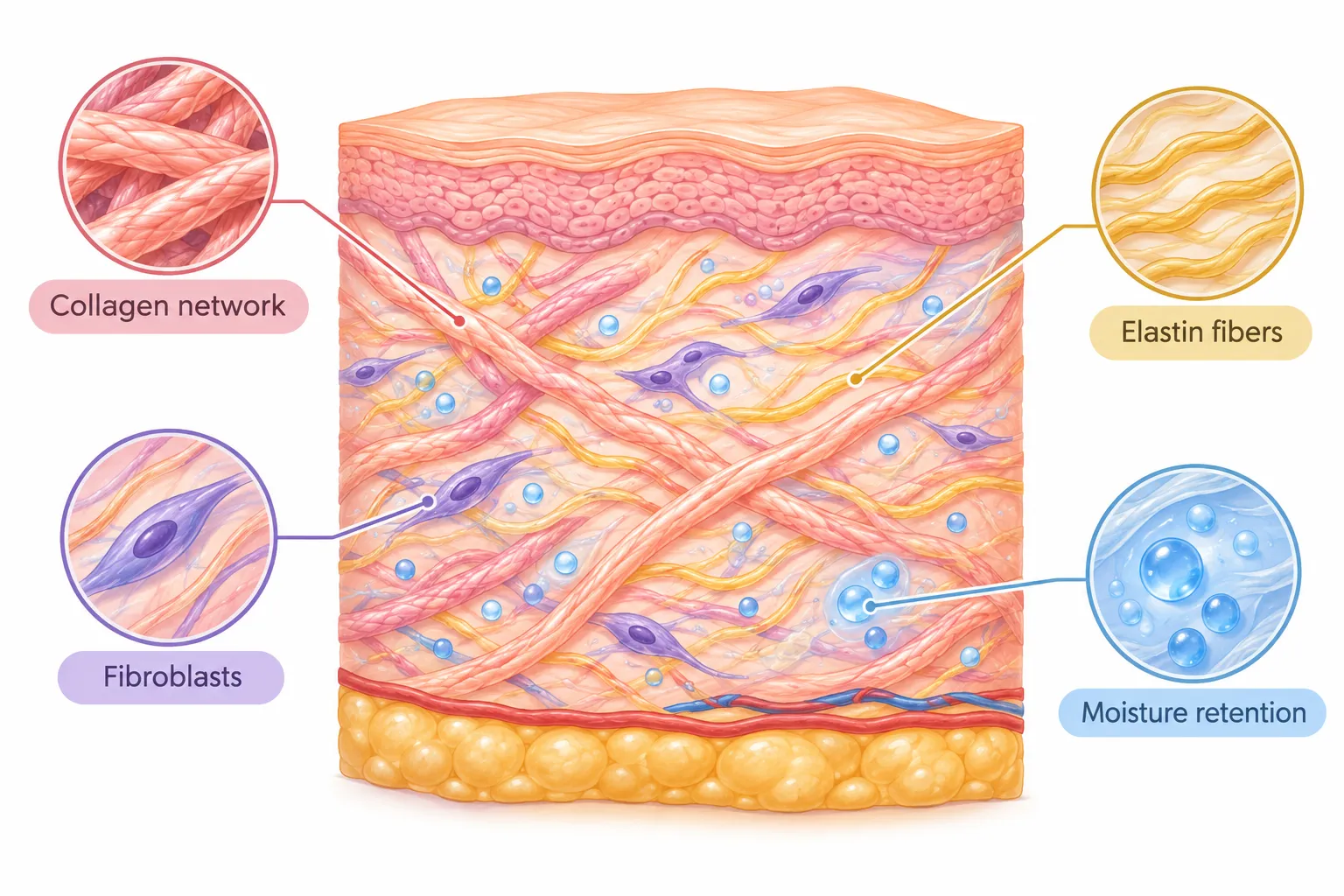
Natural collagen production slows with age, starting noticeably in the late 20s and continuing through the 30s and beyond, according to dermatology research. This decline contributes to thinner skin, sagging, and the formation of wrinkles. Sun exposure, smoking, and poor nutrition can accelerate this process.
- Collagen provides tensile strength so skin resists stretching and tearing.
- It works alongside elastin, which gives skin its “snap back” quality.
- Fibroblasts, the cells that build collagen, become less active with age.
Choose a collagen-focused approach if your main concern is skin firmness and texture rather than active breakouts or pigmentation, which have different underlying causes.
Does Collagen From Supplements Actually Get Absorbed?
Yes, hydrolyzed collagen peptides are broken down into small amino acid chains that research shows can be absorbed through the digestive tract and detected in the bloodstream. Whether those peptides travel specifically to skin tissue and trigger new collagen formation is the part scientists are still working to confirm.
Studies using hydrolyzed collagen (sometimes called collagen peptides) have found that specific peptide fragments, such as prolyl-hydroxyproline, can appear in blood after ingestion. Some laboratory research suggests these fragments may signal fibroblasts to produce more collagen and hyaluronic acid naturally. This mechanism is plausible but still considered an emerging area of research rather than settled fact.
A common mistake is assuming all “collagen” products absorb the same way. Non-hydrolyzed collagen, found in some lower-quality supplements, is a larger molecule that digests more like a regular protein and may not offer the same skin-specific signaling benefit.
Collagen vs Hyaluronic Acid for Skin: Which Is Better?
Collagen and hyaluronic acid serve different roles, so “better” depends on the specific concern. Collagen supports structural firmness over weeks of use, while hyaluronic acid (oral or topical) primarily boosts moisture and plumpness more immediately.
| Feature | Collagen Supplements | Hyaluronic Acid |
|---|---|---|
| Main role | Structural support, elasticity | Hydration, moisture retention |
| Onset of visible effect | 8-12 weeks | Days to a few weeks |
| Best delivery method | Oral peptides | Topical serum or oral |
| Evidence strength | Moderate, growing | Well established for hydration |
Choose collagen if your skin feels thin or less elastic with age. Choose hyaluronic acid if dryness and dullness are the main complaints. Many people reasonably use both, since they address different layers of the skin aging picture.
How Long Does It Take to See Results From Collagen Supplements?
Most clinical trials measuring skin hydration, elasticity, or wrinkle depth show visible changes between 8 and 12 weeks of daily use. Shorter trials under 4 weeks generally show little to no measurable difference.
- Weeks 1-4: Internal changes may be starting, but visible skin differences are unlikely.
- Weeks 4-8: Some users report subtler improvements in hydration or softness.
- Weeks 8-12: This is when most published research shows statistically measurable improvement in elasticity and wrinkle depth.
An edge case worth noting: results plateau in some studies after 12 weeks, suggesting ongoing daily use is needed to maintain benefits rather than a one-time course.
Can You Get Enough Collagen Just From Eating It?
Whole foods like bone broth, chicken skin, and fish skin contain collagen, but they rarely provide the same concentrated, hydrolyzed dose used in clinical research. Eating these foods supports general protein intake but is unlikely to replicate supplement-level results.
Vitamin C, zinc, and copper are also needed as cofactors for the body to build its own collagen, so a varied diet matters regardless of supplement use. For broader nutrition strategies that support skin from the inside, see this guide on diets for better skin that improve glow naturally.
Is Marine Collagen Better Than Bovine?
Neither source has been shown to be clearly superior for skin benefits in head-to-head human research; both marine and bovine collagen peptides have supported improvements in hydration and elasticity in separate studies. Marine collagen peptides are generally smaller in molecular size, which some researchers believe may support slightly faster absorption, though this has not translated into a confirmed difference in skin outcomes.
- Choose marine collagen if you avoid beef products or prefer a lighter taste profile.
- Choose bovine collagen if cost matters, since it’s often less expensive per serving.
- Skip marine collagen if you have a shellfish or fish allergy; most marine collagen comes from fish skin and scales.
Do Dermatologists Recommend Collagen Supplements?
Many dermatologists describe collagen supplements as a reasonable, low-risk addition to a skin care routine, but not a replacement for proven topical treatments like retinoids or sunscreen. The consensus leans toward “may help, unlikely to harm” rather than a strong endorsement.
Dermatology guidance generally emphasizes that sun protection, retinoid use, and consistent skin care routines have stronger, longer-established evidence for reducing visible aging than oral collagen alone. For practical routine-building ideas, see these anti-aging skin care tips for your 30s.
Collagen Supplements Side Effects: What You Should Know
Collagen supplements are generally considered safe for most healthy adults, with mild digestive upset being the most commonly reported issue. Fishy aftertaste or burping can occur with marine sources specifically.
- Mild bloating or fullness in sensitive individuals
- Possible allergic reaction in people with fish or shellfish allergies (marine collagen)
- Unknown long-term safety data beyond typical trial lengths of 3-6 months
- Not well studied in pregnant or breastfeeding individuals, so medical guidance is advised
Anyone with chronic kidney disease should talk to a doctor before adding extra protein supplements, since protein load can be a relevant consideration.
What’s the Difference Between Types 1, 2, and 3 Collagen?
Type 1, Type 2, and Type 3 collagen serve different structural roles in the body, and skin-focused products typically prioritize Type 1 and Type 3. Type 2 collagen is more relevant to cartilage and joint health.
- Type 1: Most abundant in skin, bone, and tendons; main focus of skin-aging research.
- Type 2: Found mostly in cartilage; relevant for joint support rather than skin.
- Type 3: Often paired with Type 1 in skin and blood vessels, supporting elasticity.
If joint discomfort is your main concern rather than skin, a Type 2-focused product may be more relevant; see this related overview of generic joint health supplements.
Does Collagen Really Help With Wrinkles and Fine Lines?
Several small to moderate randomized trials report reduced wrinkle depth and improved skin elasticity after consistent collagen peptide supplementation, though effect sizes are generally modest rather than dramatic. These are not the same as results from prescription retinoids or cosmetic procedures.
A realistic expectation: softer texture and slightly plumper-looking skin over a few months, not a dramatic reversal of established deep wrinkles. People looking for faster, more visible wrinkle reduction often combine collagen supplementation with topical retinoids and sun protection.
How Much Collagen Do You Actually Need Daily?
Most clinical studies showing skin benefits used doses between 2.5 and 10 grams of hydrolyzed collagen peptides per day. Higher doses have not consistently shown proportionally greater benefit in available research.
- 2.5g daily: Used in several hydration and elasticity studies
- 5g daily: A commonly used middle-range dose in skin trials
- 10g daily: Used in some studies, including those also measuring joint comfort
Check the supplement facts panel for the actual hydrolyzed collagen content per serving, not just the total product weight, since fillers and other ingredients can dilute the real dose.
Are Collagen Supplements Worth the Money?
For people primarily seeking modest improvements in skin hydration and elasticity, and who are comfortable with a multi-month commitment, collagen supplements can be a reasonable, low-risk investment. For people expecting dramatic wrinkle reversal, the value proposition is weaker.
Consider cost per effective daily dose (look for 2.5-10g of hydrolyzed collagen) rather than price per bottle, since underdosed products offer poor value regardless of price. Those exploring other skin-focused product categories may also want to review a Skinception product review for a topical comparison point.
Best Alternatives to Collagen Supplements for Better Skin
Collagen is one option among several evidence-backed approaches to supporting skin appearance, and combining strategies often produces better outcomes than relying on one product alone.
- Topical retinoids: Strong evidence for reducing fine lines and improving texture
- Daily broad-spectrum sunscreen: The single most protective daily habit for preventing collagen breakdown
- Vitamin C serum: Supports the body’s own collagen synthesis and brightens skin tone
- Nutrient-dense diet: Supports skin from the inside; see this guide on diets for better skin that improve glow naturally
- Adequate sleep and stress management: Chronic stress and poor sleep are linked to faster visible skin aging
What Age Should You Start Taking Collagen?
There’s no single “correct” starting age, but most people consider adding collagen supplements in their late 20s to mid-30s, when natural collagen production begins its gradual decline. Starting earlier is not harmful but may offer limited extra benefit if skin is already healthy and well cared for.
Choose to start now if you’re noticing early signs like reduced plumpness or slower skin bounce-back. Skip it if you’re in your teens or early 20s with no specific skin concern, and instead prioritize sunscreen and basic skin care habits.
Frequently Asked Questions
Does collagen supplementation cure wrinkles? No. Research shows modest improvement in skin elasticity and hydration, not a cure for existing wrinkles.
Is liquid collagen better than powder? Evidence does not clearly favor one form over the other; absorption depends more on hydrolysis quality than liquid versus powder format.
Can men take collagen supplements for skin? Yes. Research trial participants include both men and women, and benefits are not shown to be sex-specific.
Do collagen supplements interact with medications? Significant interactions are uncommon, but anyone on specific prescription regimens should check with a healthcare provider.
Is vegan collagen real? True collagen only comes from animal sources. Vegan “collagen boosters” support the body’s own collagen production through plant nutrients but are not collagen itself.
How soon is too soon to judge if collagen is working? Judging before 8 weeks is premature based on current clinical trial timelines.
Should collagen be taken with food? Most studies do not require food intake alongside collagen, though taking it with a meal may reduce mild digestive discomfort.
Conclusion
Collagen supplements are not a guaranteed fix, but current research gives a reasonably encouraging picture for people seeking modest improvements in skin hydration and elasticity over a 2 to 3 month period. The strongest results come from consistent daily use of hydrolyzed collagen peptides at researched doses, paired with sun protection and a nutrient-supportive diet.
Next steps: check the hydrolyzed collagen content on any product label, commit to at least 8-12 weeks before judging results, and pair supplementation with proven basics like daily sunscreen. Anyone with allergies, kidney conditions, or who is pregnant should check with a healthcare provider first.