 Medically Cited |
Author

Last updated: October 22, 2026
Supplements in the United States don’t get checked by the FDA before they hit store shelves. That single fact is why third-party testing exists, and why learning how to choose a third-party-tested supplement matters more than almost any other buying decision you’ll make in the wellness aisle.
Quick Answer
Choosing a third-party-tested supplement means checking for an independent certification seal (such as NSF Certified for Sport, USP Verified, or ConsumerLab Approved), confirming it on the certifier’s own website, and matching the product’s lot number to a current test report. A product without any of this is not automatically dangerous, but you’re relying on the manufacturer’s word alone, which carries real risk for purity, potency, and contamination.
Key Takeaways
- Third-party testing means an independent lab, not the supplement maker, verifies what’s actually in the product.
- NSF, USP, and ConsumerLab are the three most recognized certifiers in the US market, each with a different focus.
- Certification seals can be faked or expired, so always verify directly on the certifier’s website using the lot number.
- Third-party-tested supplements typically cost 10 percent to 30 percent more, though pricing varies by brand and category.
- Passing third-party testing confirms accuracy and purity. It does not confirm the ingredient actually works for your health goal.
- Not every supplement category needs certification equally. It matters most for athletes, protein powders, and high-risk categories like weight loss and pre-workout products.
- If you can’t find a certified version of a supplement, look for GMP-certified manufacturing and a company that publishes its own certificates of analysis.
What Does Third-Party Tested Actually Mean
Third-party tested means an independent organization, with no financial stake in the brand’s sales, has verified the product’s contents match its label. This is different from the manufacturer simply saying “tested in an FDA-registered facility,” which says nothing about what’s actually inside the bottle.
The testing typically checks three things:
- Identity, does the bottle contain the ingredient listed, and is it the correct form (for example, the right type of magnesium)?
- Potency, does the amount match the label claim, within an acceptable range?
- Purity, is the product free from heavy metals, microbes, pesticides, or undisclosed fillers?
A supplement company can pay a lab to run these tests, but the “third-party” part only counts if that lab has no ownership or financial relationship with the brand itself. According to research published by the Office of Dietary Supplements at the National Institutes of Health, independent verification programs exist specifically because premarket FDA approval isn’t required for dietary supplements in the US (NIH ODS, 2023).
Which Third-Party Testing Certifications Are Most Trustworthy
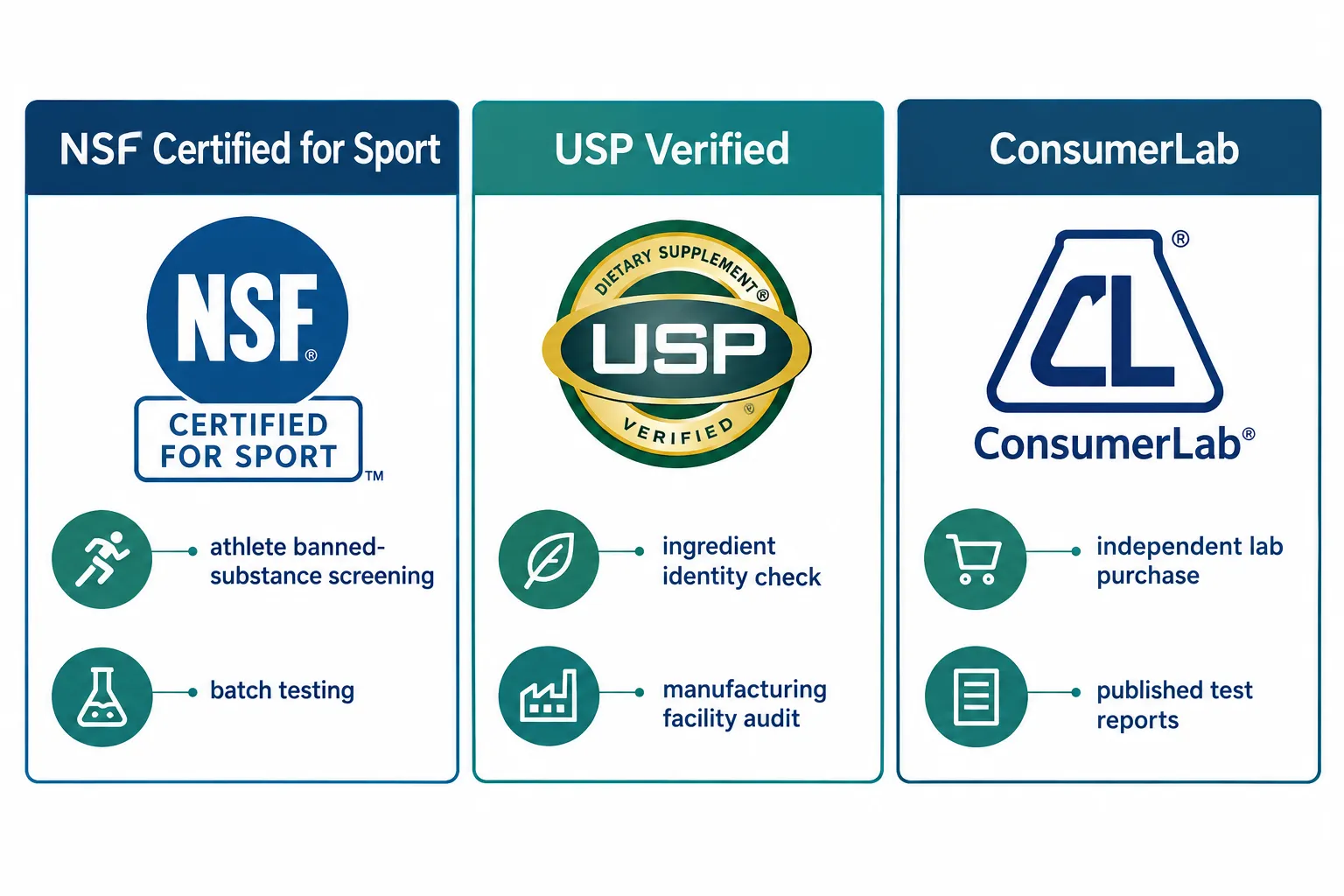
The three most established certifiers for US consumers are NSF International, USP (United States Pharmacopeia), and ConsumerLab. Each has a different scope, so the “best” one depends on what you’re buying.
| Certifier | What it checks | Best for |
|---|---|---|
| NSF Certified for Sport | Screens for 280+ banned athletic substances, plus label accuracy | Athletes, anyone drug-tested for work or sport |
| USP Verified | Ingredient identity, potency, dissolution, and manufacturing practices | General multivitamins, everyday supplement users |
| ConsumerLab | Independently purchases products off shelves and tests them, publishing results (subscription-based) | Comparison shopping across brands |
| Informed Sport/Informed Choice | Batch-by-batch banned substance testing | Competitive athletes specifically |
Decision rule: choose NSF Certified for Sport if you’re a competitive athlete or subject to workplace drug testing. Choose USP Verified for everyday multivitamins, probiotics, or fish oil. Use ConsumerLab reports when you want to compare multiple brands before buying.
How Do I Know If a Supplement Is Really Third-Party Tested
You confirm real certification by looking up the product’s seal and lot number directly on the certifying organization’s website, not just trusting the label. A seal printed on a bottle can be outdated, misapplied, or in rare cases, counterfeited.
Here’s the quick verification checklist:
- Find the certification seal on the front or back label.
- Note the lot number or batch code, usually near the expiration date.
- Go to the certifier’s website (nsfsport.com, usp.org, or consumerlab.com) and search the product name.
- Confirm the certification is current and matches the lot you’re holding.
- If the brand publishes a Certificate of Analysis (COA), check that the test date is recent, typically within the last year.
Common mistake: assuming any mention of “lab tested” on a label equals third-party certification. Many brands test in-house or hire a lab they control, then use vague marketing language that sounds independent but isn’t.
What’s the Difference Between NSF, USP, and USDA Supplement Certifications
NSF and USP certify the content and manufacturing quality of a finished supplement, while USDA certification (Organic) only verifies that ingredients were grown without synthetic pesticides or fertilizers. These are not interchangeable, and a product can carry one without the other.
- NSF focuses heavily on sport and contamination screening, plus general GMP facility audits.
- USP focuses on pharmaceutical-grade accuracy: identity, strength, and dissolution testing.
- USDA Organic has nothing to do with potency or purity testing. A supplement can be certified organic and still have inaccurate dosing, because organic certification doesn’t test the finished product’s label accuracy.
Edge case: a protein powder could be USDA Organic (grown without pesticides) but not NSF or USP certified, meaning nobody independently verified the actual protein content per scoop. Organic and third-party tested are separate claims.
How Much Do Third-Party Tested Supplements Cost Compared to Regular Ones
Third-party-tested supplements generally cost somewhat more than uncertified versions in the same category, reflecting the lab fees and audit costs brands pay to maintain certification. Exact markups vary widely by category and brand, so there’s no fixed industry-wide percentage you can rely on.
What drives the price difference:
- Certification renewal fees paid annually by the brand
- Batch-by-batch testing costs, especially for sport certification
- Smaller production runs for some certified lines, raising per-unit cost
Who should prioritize paying more: athletes subject to drug testing, people managing chronic conditions on multiple medications, and anyone buying weight-loss, pre-workout, or bodybuilding supplements, a category the FDA has repeatedly flagged for undisclosed stimulants and drug ingredients.
Who might reasonably skip the premium: someone buying a basic vitamin D or plain vitamin C from an established, reputable brand with GMP certification and a long market history, where contamination risk is lower.
Where Can I Actually Buy Third-Party Tested Supplements
You can buy third-party-tested supplements directly from certifier databases, major retailer websites with filter options, or straight from brand websites that display current certification. NSF, USP, and ConsumerLab all maintain searchable online product lists.
Practical shopping paths:
- Search NSF’s certified product list directly at nsfsport.com before shopping
- Use USP’s verified mark lookup tool on usp.org
- Filter by “third-party tested” on major retailer sites like Amazon or iHerb, then verify the claim independently
- Check specialty review sites and category guides, such as a best generic supplement for joint health comparison, which often flag certification status
What If a Supplement Fails Third-Party Testing
If a supplement fails testing, the certifier revokes or denies the seal, and the brand typically has to reformulate or pull the batch before reapplying. Consumers rarely see the failure directly; it mostly shows up as a product quietly losing its certified status or never receiving it at all.
What this means practically:
- A failed product won’t carry the certification seal, so your main defense is always verifying before you buy, not after.
- Some certifiers, like ConsumerLab, publish failed test results publicly, naming specific brands and batches.
- If you’ve already purchased a product later found to have failed testing elsewhere, stop using it and report the issue to the FDA’s MedWatch or Safety Reporting Portal.
Can I Trust the Third-Party Testing Organization Itself
Yes, for the established names, because NSF, USP, and ConsumerLab operate independently from the supplement brands they certify and publish their testing methodologies publicly. That said, not all “seals” you see on labels come from organizations with real independence or rigor.
Red flag to watch for: a certification logo you don’t recognize, with no searchable database, vague “tested” language, or a seal that seems to be created by the brand’s own parent company. Stick to NSF, USP, ConsumerLab, Informed Sport, and UL (Underwriters Laboratories) as the names with transparent, long-standing track records in the US market.
Do All Supplements Need Third-Party Testing or Just Some
Not every supplement category carries equal risk, so certification matters more in some areas than others. Categories with higher contamination or spiking risk deserve more scrutiny.
Higher priority for certification:
- Pre-workout and bodybuilding products
- Weight-loss supplements
- Sexual enhancement products
- Protein powders and sports nutrition
Lower urgency, though still worth checking:
- Basic single-ingredient vitamins (vitamin D, vitamin C) from long-established brands
- Everyday minerals like magnesium or zinc
If you’re researching nootropics or cognitive support products, categories like those covered in a guide to nootropic supplements for brain fog or brain supplement comparisons tend to involve more ingredient blends, which raises the value of independent verification.
What Are the Biggest Red Flags to Look for on Supplement Labels
The biggest red flags are proprietary blends that hide exact dosages, exaggerated claims like “cures” or “guaranteed,” and an absence of any manufacturer contact information or facility details. These signs often appear together on lower-quality products.
Watch for:
- Proprietary blend listed with a total weight but no breakdown per ingredient
- Claims that a product treats, cures, or prevents a disease (illegal under FDA rules without drug approval)
- No batch number or expiration date printed anywhere
- Pricing dramatically below category norms, which can signal cut corners
- Marketing language borrowed from prescription drugs (“clinically proven” without any cited source)
Does Third-Party Testing Guarantee a Supplement Is Safe
No. Third-party testing confirms the product contains what the label says, at the stated dose, without harmful contaminants, but it does not confirm the ingredient is effective, appropriate for your health condition, or free of interaction risk with your medications. Certification is about accuracy and purity, not efficacy.
“Third-party tested” answers the question “is this what the label says it is?” It does not answer “will this ingredient actually help me?”
Always talk to a doctor or pharmacist before starting a new supplement, especially if you take prescription medication, are pregnant, or manage a chronic condition. This applies even to certified products.
What Common Mistakes Do People Make When Buying Supplements
The most common mistake is trusting label language like “pharmaceutical grade” or “doctor recommended” as proof of testing, when these phrases have no regulated definition and require no verification at all.
Other frequent mistakes:
- Assuming a higher price automatically means better testing or quality
- Buying from third-party marketplace sellers where counterfeit products are more common
- Ignoring the “best by” date, which affects potency over time
- Stacking multiple supplements without checking for overlapping ingredients or interactions
- Skipping the step of checking dosage against what clinical research actually studied, not just what’s on the label
How Do I Read and Understand Third-Party Test Results
Reading a test report means checking the test date, the specific batch or lot number, and whether the results list “pass” for identity, potency, and contaminant screening. Reports that are vague, undated, or don’t match your product’s lot number aren’t useful verification.
A usable Certificate of Analysis should show:
- Product name and lot number matching your bottle
- Date of testing, ideally within the past 12 months
- Specific test categories: heavy metals, microbial contamination, ingredient potency
- The testing lab’s name, which you can look up independently
If a brand can’t or won’t provide this when asked, that’s worth treating as a caution sign on its own.
What Should I Do If I Can’t Find a Third-Party Tested Version of What I Need
If no certified version exists for your specific ingredient or niche formula, look for GMP-certified manufacturing, a company that voluntarily publishes its own Certificate of Analysis, and a long operating history with transparent sourcing. This isn’t equal to full third-party certification, but it narrows the risk meaningfully.
This situation comes up often with niche categories like cortisol support supplements, inositol products, or specialty weight-management formulas such as those reviewed in a GLP-1 supplement guide, where certified options are less common than for mainstream vitamins.
Practical fallback steps:
- Confirm GMP (Good Manufacturing Practice) certification on the label.
- Email the company directly and request their most recent COA.
- Check if the brand appears in independent review roundups or comparison guides.
- Favor brands manufactured in the US, EU, or other regions with stricter facility oversight.
FAQ
Is third-party testing required by law for supplements in the US? No. The FDA does not require premarket third-party testing for dietary supplements. Certification is voluntary and paid for by the brand.
Does NSF Certified for Sport mean the supplement is banned-substance free forever? It means the specific tested batch passed screening for over 280 substances at the time of testing. It doesn’t guarantee every future batch is identical without ongoing certification.
Can a supplement be third-party tested and still cause side effects? Yes. Certification confirms label accuracy and purity, not that an ingredient is risk-free for every person, especially those on medication or with health conditions.
Is ConsumerLab free to use? No, ConsumerLab operates mostly on a subscription model, though some test results are released publicly.
Are expensive supplements always third-party tested? No. Price alone is not a reliable signal of certification. Always check for the actual seal and verify it independently.
Should pregnant or breastfeeding women only buy third-party-tested supplements? Pregnant and breastfeeding women should discuss any supplement, certified or not, with their doctor first, since dosage and ingredient safety during pregnancy involve factors beyond purity testing.
Do third-party certifications expire? Yes. Certifications typically require annual renewal and reauditing, which is why checking the certifier’s current database matters more than trusting a printed seal alone.
Conclusion
Choosing a third-party-tested supplement comes down to a repeatable habit: check for a recognized seal, verify it on the certifier’s website, match the lot number, and remember that passing certification confirms purity and accuracy, not guaranteed results for your specific health goal. Start by picking one supplement you currently take, look up its certification status today, and build that five-minute verification step into how you shop going forward. For related buying considerations across specific categories, browsing category-specific comparison guides, like those covering joint health supplements or dog gut health products, can help you apply the same checklist to the products you actually use.
Sources
- National Institutes of Health, Office of Dietary Supplements, “Dietary Supplements: What You Need to Know,” 2023
- U.S. Food and Drug Administration, “Tainted Products Marketed as Dietary Supplements,” 2024
- U.S. Pharmacopeia, “USP Verified Mark Program,” 2023